
As an Amazon Associate I earn from qualifying purchases.
The best dry dog food is the one that provides appropriate nutrition for the individual dog and works within a sustainable feeding routine. A five-star review, an attractive ingredient photograph or a premium name cannot establish that fit. Begin with life stage and health needs, then compare exact formulas, practical serving details and the cost of the food your dog actually eats.
The five options below are existing candidates with their specific recipe and bag identity checked. They are not assigned a five-star nutritional score, and we have not conducted feeding trials or tested palatability. The smaller bags make these particular listings useful for comparing an initial purchase; they do not prove that a formula is suitable for every breed, budget or medical condition.
A quick route through the five candidates
- General adult beef recipe: Nutrish Beef, Pea & Brown Rice, five-pound bag.
- All-life-stages recipe to assess: Fromm Four-Star Beef Frittata Veg, four-pound bag.
- Small-breed adult texture option: Kibbles ‘n Bits Mini Bits, three-and-a-half-pound bag.
- General adult chicken recipe: Nutrish Chicken & Veggies, five-pound bag.
- Small-kibble adult chicken option: Nutrish Small Breed with Chicken, five-pound bag.
Use those categories to narrow the list, not to choose a food without reading its label. A puppy, a dog with a diagnosed dietary requirement and an adult dog eating well may need different decisions. When a veterinarian has specified a diet, follow that plan rather than replacing it with an option from a general comparison.
Nutrish Beef, Pea & Brown Rice — 5 lb

View this exact formula on Amazon
This selected listing is an adult dry food with beef as the first ingredient. It describes complete and balanced nutrition for small, medium and large adult dogs. The practical fit is an owner comparing an ordinary beef-based adult recipe in a manageable five-pound package, subject to checking the current package and the dog’s needs.
The full recipe name matters. Beef, Pea & Brown Rice identifies more than a generic beef flavor, and the rice means this is not the grain-free choice described by some shoppers’ assumptions. Do not select it as an allergy diet merely because the preferred meat appears first.
The listing describes a veterinarian-reviewed formula. That is a manufacturer claim about development, not an individualized veterinary recommendation for your dog. It also does not demonstrate that a puppy or a dog needing a therapeutic diet should eat this adult formula.
Before choosing: read the adequacy statement, calories and feeding instructions on the exact package. Compare the planned daily amount with the bag size and check whether beef suits the dog’s existing feeding plan. If the current food is already working well, identify the reason for changing before buying a different recipe.
Main limitation: an everyday adult candidate should not be treated as a universal food across life stages. The first ingredient and brand familiarity are useful identification details, but neither establishes superior nutrition over every alternative.
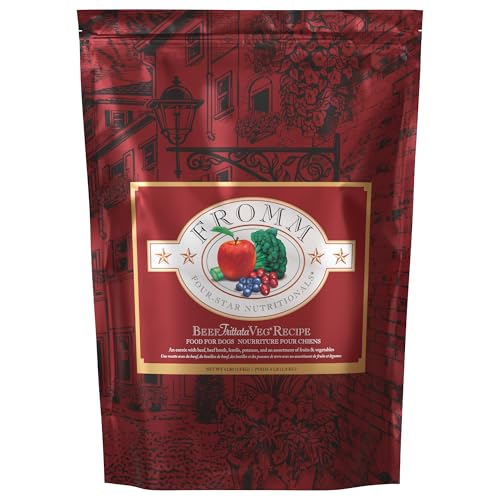
Fromm Four-Star Beef Frittata Veg — 4 lb
View this exact formula on Amazon
This four-pound selection is the Beef Frittata Veg recipe, not another Fromm beef product. The manufacturer’s recipe page states that it is formulated to meet AAFCO nutrient profiles for all life stages, including growth of large-size dogs. Check the current delivered label, especially when choosing food for a growing dog.
The manufacturer lists beef, egg, beef broth, lentils, peas and additional animal and vegetable ingredients. It gives an energy density of 399 calories per cup for the recipe. That figure helps identify the current formulation and discuss serving amounts; it is not a daily allowance for every dog.
Where it can fit: a household considering this particular all-life-stages formula with the veterinary team’s input. Evaluate each dog’s needs separately rather than assuming one bag automatically suits every animal in a mixed-age household.
Before choosing: look at the whole ingredient list if a particular protein must be excluded. A beef recipe containing other animal ingredients is not a verified single-protein diet. Ask about suitability when a dog has a diagnosed allergy or another condition requiring specific nutrition.
Main limitation: the Four-Star name is a product-line name, not an independent four-star rating. Similarly, all-life-stages adequacy does not make a food the best option for every senior dog or establish a therapeutic purpose. Price the actual daily feeding routine rather than deciding from the premium label alone.
Kibbles ‘n Bits Mini Bits Small Breed — 3.5 lb
View this exact formula on Amazon
The selected Mini Bits listing is a three-and-a-half-pound bag in Bacon & Steak flavor. It describes crunchy and tender pieces and complete and balanced nutrition for adult small dogs. That makes it a candidate for someone comparing small-breed adult foods and a mixed-texture format.
A flavor description does not establish the amount or type of meat in the recipe. Read the package ingredients rather than translating the words bacon and steak into a claim that those are the primary ingredients. The product should also remain distinct from the brand’s standard-size dry food.
Where it can fit: an adult small dog whose owner is evaluating this exact food and texture with appropriate label checks. The small package may be convenient when storage space is limited or the suitability of a larger purchase is still being considered.
Before choosing: confirm the current adult adequacy statement and calorie information. Consider whether the dog can comfortably manage the pieces, without assuming a smaller kibble treats a dental problem. Difficulty chewing or swallowing warrants veterinary advice, not simply a change in advertised bite size.
Main limitation: this is an adult small-breed comparison, not a recommendation for puppies or an established medical diet. Palatability language remains a seller claim; no food can be guaranteed to satisfy every picky dog.
Nutrish Chicken & Veggies — 5 lb

View this exact formula on Amazon
This selected five-pound bag is the adult Chicken & Veggies formula. Its title and detailed bullets describe adult nutrition for small, medium and large breeds, with chicken as the first ingredient. Those specific statements are more relevant here than a general marketplace field that inconsistently labels the age range all life stages.
Where it can fit: an owner comparing a standard chicken-based adult dry food. Keep it separate from the Small Breed with Chicken product below; the common brand and meat name do not mean the kibble, feeding instructions or recipe are interchangeable.
Before choosing: obtain the current adequacy statement and instructions for this exact formula. If the dog has an established restriction involving chicken or another ingredient, check the full list and discuss the food with the veterinarian. A familiar recipe name is not an allergy assessment.
For an owner choosing between the beef and chicken Nutrish options, begin with an actual reason for the preference. That might be a previously tolerated recipe or a clinician-approved choice. Do not assume a different meat automatically improves digestion or treats itching.
Main limitation: the listing’s veterinarian-reviewed wording does not establish suitability for a particular illness. Treat this as an adult daily-food candidate, and avoid extending its claims to puppy growth from an inconsistent shopping-page field.
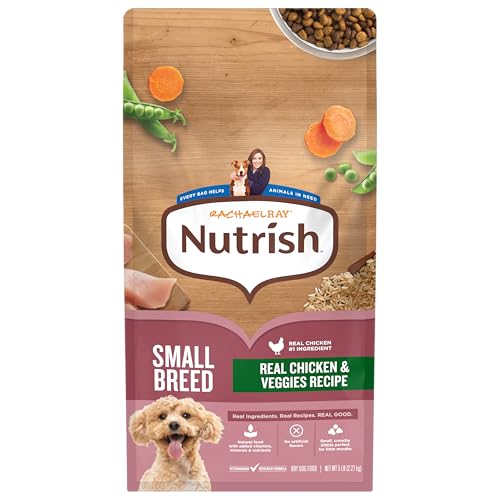
Nutrish Small Breed with Chicken — 5 lb
View this exact formula on Amazon
The selected Small Breed with Chicken listing is a five-pound bag. Its detailed description identifies small, crunchy kibble for adult small-breed dogs, with chicken as the first ingredient. The useful distinction is the specific adult small-breed format, not a promise of easier digestion for every small dog.
Where it can fit: an owner comparing a chicken-based adult option with smaller pieces. Assess the current product against the dog’s feeding plan and obtain its adequacy statement; the marketplace’s broader all-life-stages metadata should not become a puppy recommendation.
Before choosing: compare the actual calorie information and serving instructions with the standard Chicken & Veggies recipe. Do not assume either that small-breed food always contains more calories or that identical cup portions suit both products.
Think through how a five-pound bag will be used in your household. Record the approved daily amount, storage directions and expected use. A smaller dog may use food more slowly, so the manageable package is worth considering alongside the price of larger quantities.
Main limitation: small kibble is a format feature, not proof of dental treatment, medical suitability or nutritional superiority. A small-breed label cannot replace assessment of the actual dog, especially when eating behavior has changed.
Buying guide: make nutrition the first filter
Read the adequacy statement accurately
AAFCO explains that it does not approve or certify pet foods. The useful label detail is how the food states its nutritional adequacy, not a claimed AAFCO approval badge. Look for the species and intended life stage and ask about unclear wording.
AAFCO’s label guide distinguishes formulas meeting nutrient profiles, feeding-test statements and products intended for intermittent or supplemental use. Check the complete statement on the current package. A topper or snack should not silently replace a food intended as the main diet.
For a puppy, confirm that the selected formula addresses growth and the relevant adult size. For an adult, identify the maintenance plan and any individual health needs. For a senior dog, discuss current condition and feeding goals rather than treating senior as proof that any all-life-stages recipe is ideal.
Avoid ingredient shortcuts
A named meat first is not a complete quality assessment. The WSAVA nutrition resources explain that an ingredient list alone can mislead about overall quality. Use it to identify ingredients, then investigate the formula’s nutritional information and suitability.
Do not diagnose an allergy from a brief change in stools or an online review. If the dog needs an elimination or therapeutic diet, obtain a veterinary plan. Switching among several ordinary foods can make it harder to describe what the dog has actually eaten.
Grain-free is a separate decision
Grain-free wording should not automatically move a food to the top of the list. The FDA’s investigation of diet and canine dilated cardiomyopathy concerns a complex possible association, including reports involving diets with substantial pulses or potatoes. The agency notes that adverse-event reports alone cannot establish causation. Discuss the actual recipe and your dog’s needs rather than concluding that every grain-free food is either necessary or harmful.
Compare value by the daily feeding routine
Start with the actual selected bag and current delivered price. Divide cost by bag weight to compare quantities of the same formula. Then consider the amount the individual dog is meant to receive. Equal bag weights do not automatically represent equal numbers of meals.
For an illustrative calculation, a hypothetical bag costing twenty dollars and providing twenty days of the approved feeding amount costs one dollar per day. Another costing thirty dollars and providing fifteen days costs two dollars per day. These are arithmetic examples, not current product prices or feeding directions.
Account for delivery, unusable leftovers and storage constraints. A large bag can be good value when the dog is established on that formula and it can be used properly. A smaller initial quantity can be more practical when acceptance or the final feeding plan remains uncertain.
Check subscriptions carefully: selected formula, recurring quantity and cancellation conditions. Avoid committing to a large recurring supply before you know which exact product you intend to use. Reassess the order if the veterinarian changes the food or serving plan.
A compact comparison sheet
Make one row for each formula you are seriously considering. Use columns for exact recipe, intended life stage, adequacy statement, calorie information, selected bag weight, delivered price and unresolved questions. Limit the sheet to suitable candidates rather than adding every food with a high review count.
Leave an entry blank when the information is missing. For example, if one listing does not show the current package’s calorie statement, ask the manufacturer for that detail instead of borrowing it from a different bag or recipe. A blank identifies a useful next question; a guessed figure can make a comparison look settled when it is not.
Once the nutritional questions are resolved, add the practical details: the dog’s established preference, your storage space and the expected order frequency. If two foods remain reasonable options, those ordinary considerations can help you choose. They should not override a life-stage mismatch or a clinician’s instructions.
Save the final sheet with the selected package photograph. When you reorder, compare the formula and size again, particularly if the marketplace has moved to a different default option. Keeping that short record is easier than reconstructing why a product was selected after several months of purchases.
Small-breed versus standard adult options
For a healthy adult small dog, compare the small-breed candidates with the general adult formulas by reading their actual directions and checking their fit with the dog’s routine. The most relevant distinction may be the advertised piece size, but it should be considered alongside the nutritional statement and calories.
For a larger adult dog, do not choose a small-breed option solely because the smaller bag has an appealing price. Compare the amount needed, the intended use and the product information. Package convenience should follow a suitable food decision, rather than determining it.
Receiving, storing and serving dry food
Inspect the delivered bag for the correct formula, size, date information and damage. Keep the lot details available. The FDA’s storage guidance recommends retaining the original package; if using another container, place the bag inside it. Store food appropriately and follow the product’s handling directions.
Write the opening date and keep the current instructions with the food. When several people feed the dog, agree on the measuring unit and who records meals. A scoop without a defined size makes it easy for the household’s estimate of intake to drift.
Follow the manufacturer’s and veterinarian’s transition advice for the individual dog. Avoid imposing one fixed schedule on every animal or repeatedly rotating recipes because a line is marketed as interchangeable. Record appetite and any changes requested by the clinic, and seek advice if the dog is unwell.
Final checks before selecting a bag
- Confirm the exact recipe and current nutritional adequacy statement.
- Match the intended life stage and any veterinarian-specified requirements.
- Check the full ingredients when an established restriction applies.
- Use actual calories and feeding instructions rather than assumed cup portions.
- Compare the delivered cost and quantity within the planned routine.
- Choose a package you can store and use correctly.
- Keep the label and lot information with the feeding record.
Questions readers often ask
Are these foods independently rated five stars? No independent star score or feeding-test result is assigned here. Evaluate the specific formula and the dog’s needs.
Does Four-Star mean a four-star review? It is the Fromm product-line name, not a score awarded by this guide.
Can adult food be used for every puppy? Do not assume that. Check growth suitability and obtain guidance for the individual puppy.
Does smaller kibble guarantee easier digestion? No such guarantee follows from piece size. Consider the whole food and seek advice about eating problems.
What is the best starting point? Identify the dog’s nutritional needs, then compare exact formulas that meet those needs and a feeding routine you can maintain.