
Choosing the right hand milking machine can boost dairy productivity while reducing cow stress. This guide highlights five reliable models that balance efficiency, portability, and animal welfare. Each entry includes key features, suitability, and a quick reference to help farmers compare at a glance.
Summary Of Chosen Products
| Product | Brand | Capacity | Key Benefit | Link |
|---|---|---|---|---|
| Cow Milking Machine Portable | GarveeTech | 25 L / 6.6 gal | High pulsation range; durable stainless bucket | Amazon |
| Electric Milking Machine 14L | MAPOTAD | 14 L | Rechargeable with long battery life | Amazon |
| 10L Portable Milker | Enkreefi | 10 L | Check valve design; efficient one-person operation | Amazon |
| Electric Milking Machine 25 L | GAOMON | 25 L | Strong motor; hygienic stainless bucket | Amazon |
| KHEARPSL 8L Two-in-One | KHEARPSL | 8 L | Two-in-one for cow/goat; rechargeable | Amazon |
id=”garveetech”>GarveeTech Cow Milking Machine Portable

The GarveeTech portable milking system operates with a 550W motor delivering 1680 RPM and 60-80 pulsations per minute. Its ergonomic design supports operator comfort during extended milking sessions, while a robust motor maintains performance in varying weather. This model is suitable for farms of multiple sizes, aiming to boost efficiency through consistent milking cycles and reliable power delivery.
Animal-friendly pulsation is achieved via adjustable vacuum (45-50 kPa), mirroring calf-sucking rhythms to minimize udder stress and support healthy blood flow. Silicone cups provide a gentle, non-abrasive interface, which can contribute to improved milk yields by creating smoother milking cycles. A 25 L food-grade stainless bucket and 8.2 ft silicone tubing help maintain hygiene and reduce contamination risk in raw milk handling.
id=”mapotad”>MAPOTAD 14L Cow Electric Milking Machine

The MAPOTAD model emphasizes efficiency with a pulsation cycle of about 40-46 times per minute and a 13200 mAh rechargeable battery, supporting up to around 3 hours of operation on a full charge. A large 14L milk bucket allows milking multiple cows in a single session. The device includes a check valve to prevent milk backflow and reduce downtime during milking, with a knob to adjust motor frequency for cow comfort.
Materials prioritize safety: food-grade silicone hose and teat cup liners, plus a milk container built for hygienic handling. The design supports both cows and goats, offering a practical solution for small to mid-sized operations seeking portability with dependable performance and battery-powered flexibility.
id=”enkreefi”>Enkreefi 10L Portable Milking Machine

Enkreefi offers a compact 10L milker designed for one-person operation with a pulsation rate of 43-46 times per minute. The design emphasizes a backflow-check valve to prevent milk from returning to the pump, saving time and reducing clean-up complexity. Its portability makes it suitable for small herds or farmers who move between barns.
The unit focuses on a balance of performance and practicality, with a bionic-inspired pulsation approach to approximate manual milking rhythms. The adjustable suction helps tailor comfort to each cow, supporting welfare while maintaining efficient throughput for single handlers.
id=”gaomon”>GAOMON Electric Milking Machine
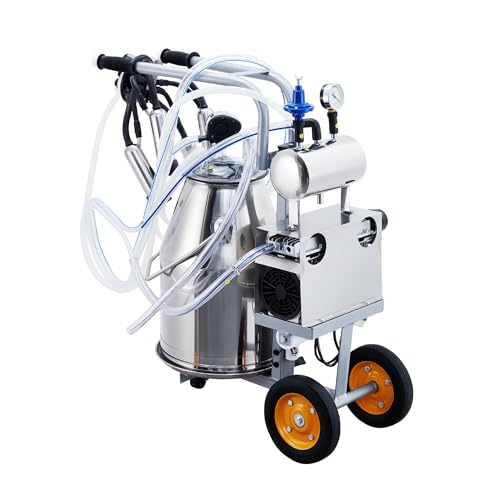
The GAOMON milking machine features a 550 W motor at 1680 RPM, delivering 60-80 milking cycles per minute. The 25 L stainless steel bucket maintains milk freshness by mitigating oxidation and contamination. Silicone cups offer a comfortable interface, reducing udder stress and aligning milking cycles with natural rhythms.
Hygienic design includes food-grade silicone hoses and a closed-loop milk path, supporting regulatory compliance and straightforward cleaning. The combination of high throughput and attention to milk quality makes this model a strong option for farms prioritizing both efficiency and product safety.
id=”khearp sl”>KHEARPSL 8L Two-in-One Milker

KHEARPSL’s 2-in-1 design includes separate cups for cows and goats, enhancing versatility and cost efficiency for mixed herds. The device is rechargeable, with a built-in battery to operate even where power outlets are unavailable. It’s positioned for ease of use in barns or on farms that require mobility without sacrificing milking speed.
Two milking cup sets enable rapid switching between species, and the device emphasizes portability and practicality for farmers who manage diverse livestock. The model targets efficient milking times while supporting animal comfort with a thoughtfully designed suction system and adjustable settings.
Buying Guide
- Herd size and mobility: For small-to-mid-sized farms, consider models with a rechargeable battery and a portable bucket (MAPOTAD, Enkreefi, KHEARPSL). Larger operations may benefit from bigger buckets and higher pulsation capacity (GarveeTech, GAOMON).
- Milk hygiene and storage: Look for a stainless steel bucket (25 L or more) and food-grade silicone hoses to minimize contamination risk and preserve milk quality.
- Animal welfare: Prioritize adjustable vacuum/pulsation parameters (45-50 kPa typical) and silicone teat cups to reduce udder stress and improve cow comfort during milking cycles.
- Ease of use and maintenance: Machines with clear check valves prevent milk backflow and simplify cleaning. A modular design that allows quick cup/hose replacement can save downtime.
- Power availability: If the farm lacks reliable electricity, rechargeable models or battery-assisted units provide greater flexibility, especially in barns without power sockets.
- Compatibility: Some models are designed for both cows and goats, which is advantageous for mixed herds. Ensure cups and liners fit your livestock comfortably.
- Durability and warranty: Stainless steel components and robust motors help withstand farm conditions. Check warranty terms and replacement part availability.
The selection above provides options across needs—from portable, battery-backed devices to higher-capacity, plug-in machines. When evaluating, consider total milking time saved, ease of cleaning, and how the unit integrates with existing milk handling and storage routines. This approach helps ensure consistent milk quality while reducing labor costs and cow stress.