
Keeping aquarium water clean is essential for fish health. The right test strips provide fast, reliable readings for key parameters like pH, ammonia, nitrates, nitrite, and alkalinity. This guide highlights five top-rated options, comparing their coverage, accuracy, and ease of use to help hobbyists pick the best test strips for their fish tanks—whether freshwater or saltwater.
style=”display:none;”>Summary Table Of Chosen Products
- SJ WAVE 11 in 1 Aquarium Test Strips
- AAwipes 8-in-1 Aquarium Test Kit (K02-50)
- API 5-IN-1 Test Strips (100-count)
- FUNSWTM 9-in-1 Aquarium Test Strips (150ct)
- LabBestest 7-Way Aquarium Test Strips (150)
SJ WAVE 11 in 1 Aquarium Test Strips

SJ WAVE offers a comprehensive 11-parameter test kit designed for both freshwater and saltwater tanks. It covers ammonia, pH, iron, chlorine, total hardness (GH), carbonate, nitrate, nitrite, total alkalinity, copper, and temperature. The kit emphasizes easy, at-home testing with color charts for quick interpretation, helping detect subtle water quality changes before issues arise.
Designed for rapid results, these strips are intended to be dip-tested with color chart references for quick action. The kit also includes an aquarium thermometer and an ebook, aiming to provide a complete home-water-testing solution. While providing broad parameter coverage, readers should verify color interpretation under varying lighting conditions for consistency.
Pros: Wide parameter range, clear color charts, home-ready kit. Cons: Reading accuracy can depend on lighting and timing; occasional batch variation may occur.
AAwipes 8-in-1 Aquarium Test Kit
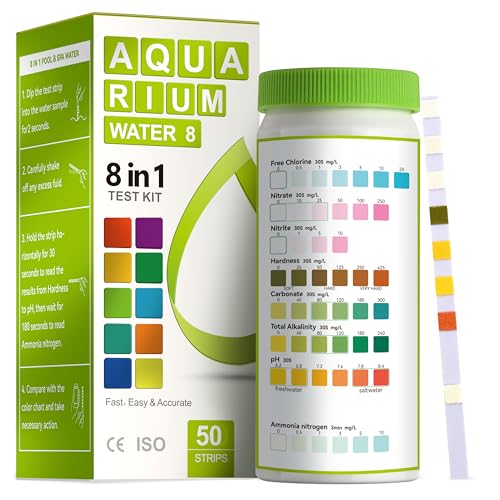
AAwipes provides an 8-in-1 testing kit suitable for freshwater and ponds. It measures Free Chlorine, Nitrate, Nitrite, Hardness, Carbonate, Total Alkalinity, pH, and Ammonia nitrogen. The kit emphasizes fast results in minutes with a straightforward three-step process, aiming for up to 99% color-accurate readings when compared to the chart.
Highlights include a compact 50-strip pack, designed for regular monitoring to prevent hidden water issues. It’s marketed as versatile for various aquatic environments—from home aquariums to ponds and shrimp tanks. For some users, precise color matching remains essential for consistent interpretation.
Pros: Broad 8-parameter coverage, quick results, versatile use. Cons: Slightly more complex chart comparisons; color matching may require good lighting.
API 5-In-1 Test Strips

API’s 5-in-1 strips cover essential indicators for both freshwater and saltwater, including pH, nitrite, nitrate, carbonate hardness, and general hardness. The kit emphasizes simplicity: dip the strip, compare the color to the chart, and read results quickly for straightforward monitoring. It’s a familiar option for hobbyists seeking a reliable baseline assessment of water quality.
API strips are widely available and known for consistency in color interpretation across batches. They are well-suited for routine checks or for beginners building a basic testing routine. Readers should still cross-reference with periodic full-panel tests for high-precision needs.
Pros: Simple, time-efficient 5-parameter check; widely available. Cons: Fewer parameters than some 8- or 9-in-1 kits; color matching matters for accuracy.
FUNSWTM Aquarium Test Strips 9-in-1

FUNSWTM offers a 9-in-1 test strip kit with a 150-count value pack. It tests nine parameters—Ammonia, pH, Nitrate, Chlorine, Nitrite, Hardness, Alkalinity, and Copper—across freshwater and saltwater setups. The kit emphasizes quick, easy testing with clear color charts and aims to provide fast, reliable results for routine monitoring and early problem detection.
Pros: Wide parameter coverage including ammonia; large value pack; quick results. Cons: Ammonia-specific results can be sensitive to timing and reading conditions; interpretation can vary with lighting.
LabBestest 7-Way Aquarium Test Strips

LabBestest provides a 7-way test strip kit designed to deliver a comprehensive snapshot of water quality in one strip. It covers seven key parameters, enabling hobbyists to monitor pH, carbonate, hardness, and more. The kit emphasizes speed and ease of use with rapid results in about 30 seconds, leveraging high-sensitivity materials for reliable data.
Pros: Balanced parameter set; rapid results; good value for 150 strips. Cons: Fewer parameters than 8- or 9-in-1 kits; color matching remains essential for accuracy.
Buying Guide: Key Purchase Considerations
- Parameter needs: Determine which indicators you must monitor (pH, ammonia, nitrite, nitrate, hardness, alkalinity, copper, etc.). If ammonia is critical due to recent fish introduction or a new tank, prioritize kits with a dedicated ammonia parameter.
- Tank type and size: Freshwater vs. saltwater requirements and tank volume influence the ideal kit. Some strips perform equally across environments; others may bias readings under certain salinities.
- Number of tests per pack: Larger packs offer better long-term value, but ensure you will use them within the product’s shelf life. Regular testing frequency (twice weekly or more) supports stable water quality.
- Ease of use and speed: Consider how many steps are required, how quickly results appear, and whether a color chart is easy to read under typical room lighting.
- Accuracy and reliability: Look for kits with consistent color matching and clear instructions. Some brands offer corroborating guidance, such as included color charts or reference loops to reduce misreads.
- Compatibility and coverage: If you maintain multiple tanks, a kit with multiple parameter coverage can simplify management. Some kits also include extra tools or accessories (thermometer, ebook) for added value.
- Cost per test: Compare price per strip or per test when evaluating long-term value, not just the upfront pack price.
- Quality certifications (where available): Some brands emphasize lab-grade components or ISO certifications as markers of reliability.
How To Use Test Strips Effectively
- Read the instruction sheet before use to understand the exact timing for dipping and reading each parameter.
- Rinse or shake excess water lightly after dipping if the kit’s guidance requires it, then hold the strip horizontally for the specified time before comparing colors.
- Read results in consistent lighting. If possible, use the same lighting each time to minimize color-reading variability.
- Record results in a log to monitor trends over days or weeks, which helps detect gradual water quality shifts.
- Correlate strips with periodic professional tests if precise calibration is needed for high-density or sensitive species.
In summary, choosing test strips involves balancing parameter coverage, ease of use, and value. For hobbyists who want broad monitoring without complexity, 8- or 9-in-1 kits with clear color charts are strong options. If you keep a smaller tank or prioritize ammonia tracking, a 7- or 5-parameter kit may suffice. Regular testing and a consistent routine provide the best chance of maintaining a healthy aquarium environment.