
Choosing the right UVB lighting is essential for turtle health, aiding calcium absorption and shell development. The following bulbs are popular, reefing on UVB output and reliability to support tropical and subtropical turtle species. This guide highlights five top options, their key features, and how to select the best fit for your terrarium.
| Product | Brand | UVB Output | Approx. W | Notes |
|---|---|---|---|---|
| REPTI HOME UVB Reptile Light 5.0 | REPTI HOME | 5.0 UVB | 13W | Great for tropical setups; ECO-friendly design |
| LUCKY HERP UVA UVB Reptile Light 10.0 | LUCKY HERP | 10.0 UVB | 23W | Long-lasting; balanced UVA/UvB spectrum |
| Zoo Med ReptiSun 10.0 Mini | Zoo Med | 10.0 UVB | 13W | Quartz glass for UVB penetration |
| Zoo Med ReptiSun 5.0 Mini | Zoo Med | 5.0 UVB | 13W | All tropical species support |
| REPTI ZOO UVB Light 10.0 2 Pack | REPTI ZOO | 10.0 UVB | 26W (per bulb) | Dual-pack with long lifespan |
REPTI HOME UVB Reptile Light 5.0 — 13W

REPTI HOME’s 5.0 UVB bulb provides essential UVB rays to support vitamin D3 synthesis and calcium absorption. Designed in the US with a durable glass tube and stable electronics, it delivers reliable UVB output with minimal fading. Compatible with E26 sockets and suitable for tropical reptiles such as chameleons, iguanas, and turtles. Maintain a recommended distance of at least 20 cm from the reptile to ensure safe exposure. The bulb also emits UVA to encourage natural behaviors like feeding and daily activity.
LUCKY HERP UVA UVB Reptile Light 10.0

LUCKY HERP’s 10.0 UVB bulb delivers 10% UVB with 30% UVA, designed to simulate natural desert sunlight. It focuses on stable, long-lasting output with a lifespan up to about a year, reducing bulb changes. The higher UVB level supports vitamin D3 production, calcium absorption, and skeletal health, while UVA enhances feeding, reproduction, and exploration. The bulb’s high color rendering helps reptiles appear more vibrant under light.
Zoo Med ReptiSun 5.0 Mini

Zoo Med’s ReptiSun 5.0 Mini provides 5% UVB and 30% UVA, using UVB-transmitting quartz glass to maximize penetration. This makes it suitable for all tropical reptiles and amphibians in compact enclosures. The design emphasizes steady output and longevity, making it a practical option for daily turtle care where bright, consistent lighting is desired without excessive heat.
REPTI ZOO UVB Light 10.0 2 Pack
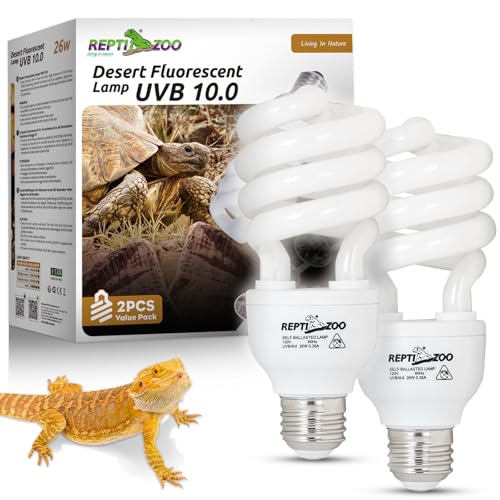
REPTI ZOO provides a dual-pack of 10.0 UVB bulbs, delivering robust UVB exposure with a long lifespan up to 10,000 hours. The bulbs mimic tropical sunlight with 5% UVB and 30% UVA, supporting calcium metabolism and promoting natural behaviors. The pair-backed design reduces replacement frequency and ensures continuous UVB coverage in turtle habitats requiring regular basking zones.
Buying Guide
- UVB rating: For turtles, look for 5.0 to 10.0 UVB outputs. Higher output is often beneficial for active basking species but requires careful placement to avoid overheating.
- Distance and safety: Most bulbs require mounting fixtures and should be positioned at an appropriate distance (commonly 20 cm or more) to prevent burns while maximizing UVB exposure.
- Lamp type: Compact fluorescent bulbs (CFLs) are common for small enclosures; consider UVB transmitting quartz glass bulbs for better UVB penetration.
- Longevity and consistency: Bulbs with longer lifespans reduce replacements. Look for bulbs with stable UVB output and minimal fading over time.
- Full-spectrum balance: UVA complements UVB by supporting natural behaviors; aim for bulbs that deliver a balanced UVA/UVB mix aligned with your turtle species’ needs.
- Fixture compatibility: Ensure the bulb fits your fixture (E26 socket compatibility is common) and check heat output to avoid overheating enclosures.
- Redundancy: A dual-pack option can provide backup UVB exposure, reducing risks if one bulb fails.
- Species considerations: Bearded dragons and tortoises may benefit from higher UVB levels, while semi-aquatic turtles may require a combination of UVB and heat sources for basking.